
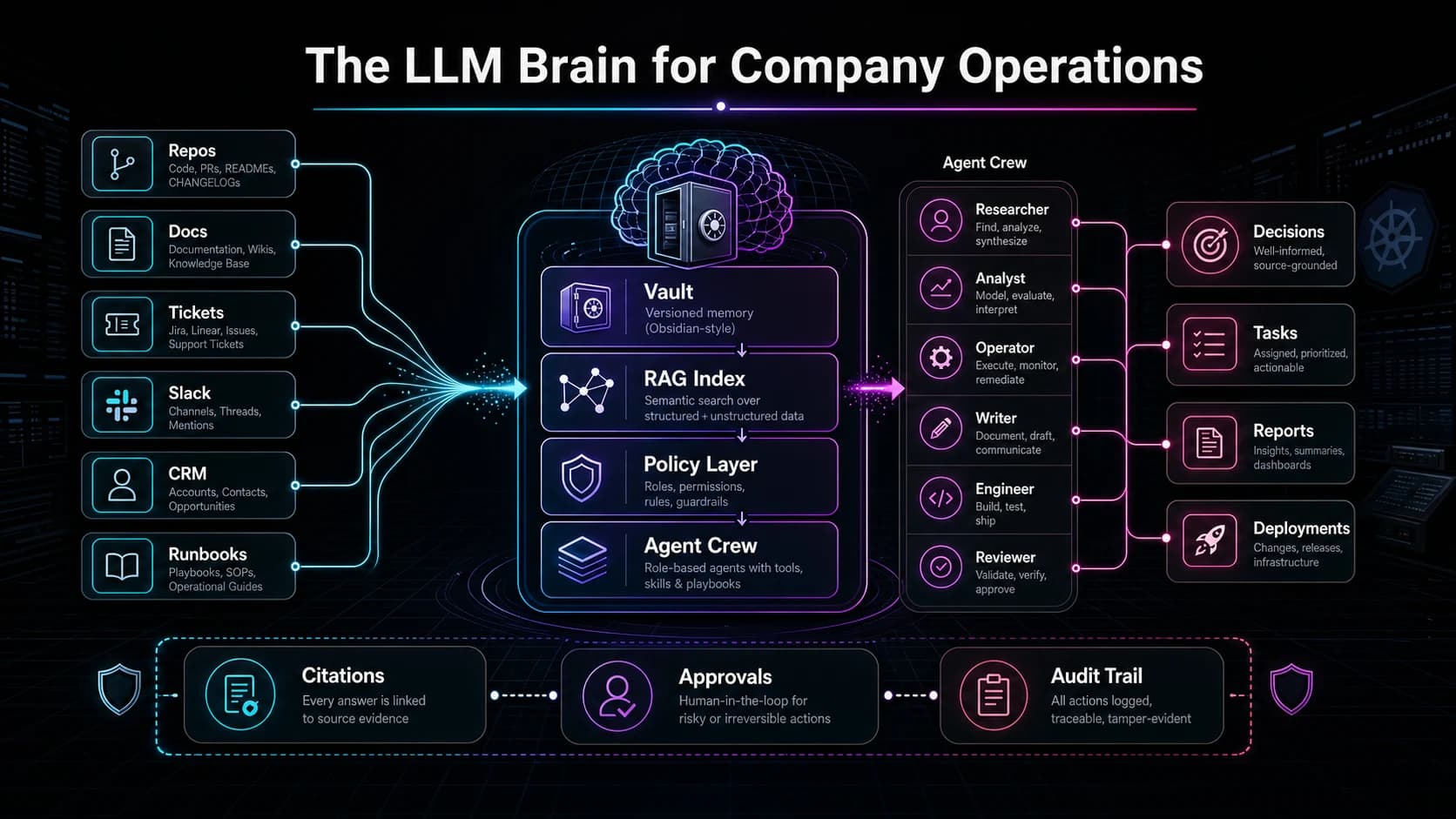
The fastest way to build a disappointing agent is to start and end with the prompt. The prompt matters, but it cannot remember company decisions, enforce permissions, show operators what happened, or recover from a bad action. A prompt is a component. It is not an operating system.
When CloudFloo designs agent workflows, we treat the model as one part of a larger operating layer. That layer needs memory, retrieval, roles, approvals, audit trails, scheduled work, task visibility, and deployment discipline. Without those pieces, "autonomous" often means "invisible and hard to trust."
Durable memory beats chat history
Chat history is not enough for company operations. Teams need a durable record outside the current session: decisions, tasks, runbooks, project notes, source briefs, daily logs, incidents, handoffs, and known constraints. The agent should be able to read that memory, but it should not be the only place the memory exists.
Durable memory changes the quality of the workflow. It lets the system reuse decisions instead of rediscovering them. It gives reviewers something to inspect. It makes handoffs possible when a different person or agent picks up the work later.
Retrieval must be source-grounded
RAG is not just vector search. For operational work, retrieval should connect answers back to source paths, timestamps, documents, tickets, dashboards, or repository evidence. If an agent cannot show where a claim came from, the claim should be treated as weak until verified.
This is especially important in engineering and go-to-market work. A content draft can overstate proof. A migration plan can miss an environment-specific constraint. A support answer can cite stale behavior. Source-grounded retrieval makes the uncertainty visible.
Roles reduce chaos
One generic assistant becomes messy as soon as the work touches research, implementation, operations, writing, and review. Role-based agents make ownership visible. A researcher gathers evidence. An engineer proposes a patch. A reviewer looks for risk. An operator checks production behavior.
Roles also make permissions easier to reason about. A writer does not need deployment permissions. A researcher does not need billing access. An operator might need read access to logs but not permission to run a migration. The role should narrow the tool surface.
Approvals are part of the product
Approval gates should not be bolted on after the demo. They are part of the product. If an agent can send external messages, update a CRM, open a pull request, deploy a service, or change billing state, the operator needs to see what will happen before it happens.
- What source material was used.
- What action is being proposed.
- What systems will be changed.
- Why the action is considered safe.
- How to reverse it if the result is wrong.
The control surface matters
Operators need a place to see tasks, schedules, failed jobs, approvals, recent outputs, and action history. Without that surface, agent work disappears into transcripts and background jobs. That is not an operational system. It is a debugging liability.
A useful control surface does not need to be complex at first. It needs to answer practical questions: what is running, what failed, what needs approval, who owns the next step, what changed, and where is the evidence?
The lesson for buyers
If a vendor sells you an autonomous agent but cannot explain memory, permissions, citations, approvals, telemetry, and rollback, they are selling a prompt demo, not a production system.
Design the operating layer before scaling agents
CloudFloo can help design memory, retrieval, permissions, approvals, workflow UI, and deployment paths for agents that need to work inside real company systems.
Get a process review