
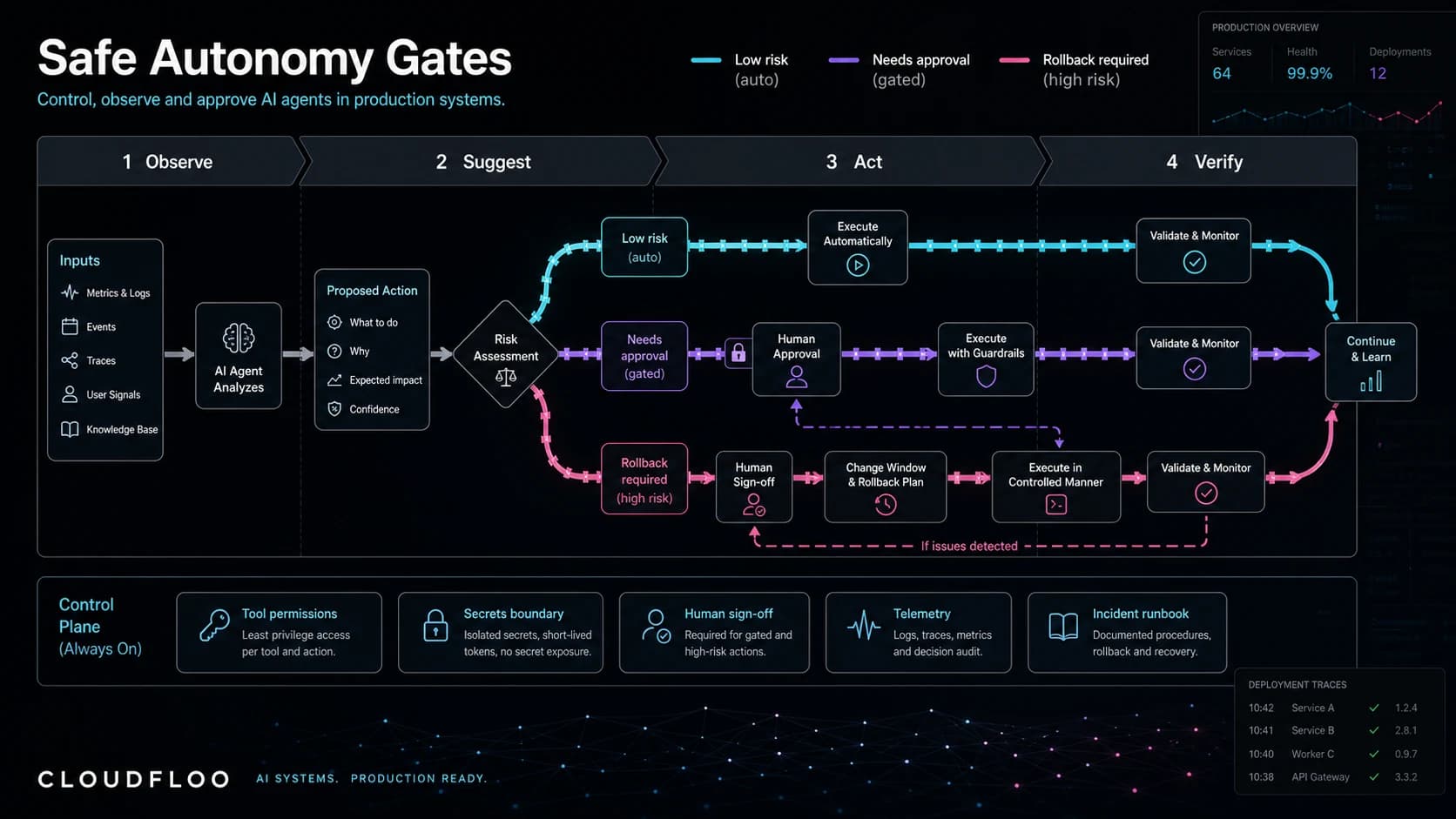
Companies usually ask the wrong first question about agents. They ask, "Can an agent do this?" The better question is, "What happens if the agent is wrong, late, incomplete, or overconfident?" That reframes autonomy as a risk classification problem instead of a novelty demo.
A production AI workflow should classify actions before it grants tools. The same model can summarize a support thread, open a pull request, update billing metadata, or deploy a service. Those actions do not carry the same blast radius, so they should not share the same permissions.
Gate 1: low risk actions can run automatically
Low-risk actions are reversible, internal, and cheap to inspect. If the output is wrong, the company loses a few minutes, not customer trust or production data. This is where agents should start because the feedback loop is fast and the safety cost is low.
- Draft internal summaries from cited source material.
- Classify tickets or content briefs for review.
- Suggest test cases or acceptance criteria.
- Update non-production documentation.
- Prepare a proposed change list for a human owner.
Even here, autonomy still needs controls. The agent should have narrow tool permissions, source citations where possible, sampling review, and a clear record of what it changed. The point is to make low-risk work faster without training the organization to accept invisible automation.
Gate 2: medium risk actions need approval
Medium-risk actions affect other people or shared systems, but they are still reversible. These are good candidates for human-in-the-loop workflows. The agent does the preparation work. A person reviews the output, checks context, and approves execution.
- Open a pull request from a bounded implementation task.
- Create a calendar event or task in an operational system.
- Prepare customer-facing copy before it is sent.
- Update status across Jira, Linear, GitHub, or CRM systems.
- Change a CMS draft that will later become public content.
The approval UI matters. A reviewer should see the source, the proposed diff, the reason for the action, and the fallback. "Approve" should never mean "trust the transcript." It should mean the system has made the risk visible enough for a responsible person to decide.
Gate 3: high risk actions require rollback before execution
High-risk actions can affect production, money, customer data, reputation, or legal exposure. These actions need more than approval. They need a rollback path, observability, and an incident plan before execution. If the team cannot describe how to recover, the agent should not be allowed to act.
- Production deploys and infrastructure changes.
- Data migrations, destructive updates, or bulk edits.
- Billing changes, plan changes, invoices, refunds, or credits.
- External messages sent as the company.
- Actions involving secrets, customer data, or regulated workflows.
Approval is not enough for production risk.
A human can approve the wrong thing. High-risk autonomy needs a recovery mechanism: rollback command, previous artifact, backup, feature flag, kill switch, runbook, dashboard, and named owner.
The controls that make autonomy usable
Safe autonomy gates work best when they are built into the product and operations layer. That usually means role-based permissions, scoped tools, audit logs, telemetry, and clear ownership. The model should not discover its own permissions at runtime. The system should grant the least power needed for the task.
CloudFloo applies this model to agent workflows in product, content, DevOps, and internal operations. Agents can speed up research, planning, drafting, triage, and repetitive operations. Deterministic software owns the critical rules. Humans approve irreversible or reputation-sensitive work. Production changes stay observable and reversible.
Map your autonomy gates before adding agents
CloudFloo can help classify actions, define tool permissions, add approval paths, and design rollback-safe execution for AI workflows inside real company systems.
Get a process review