
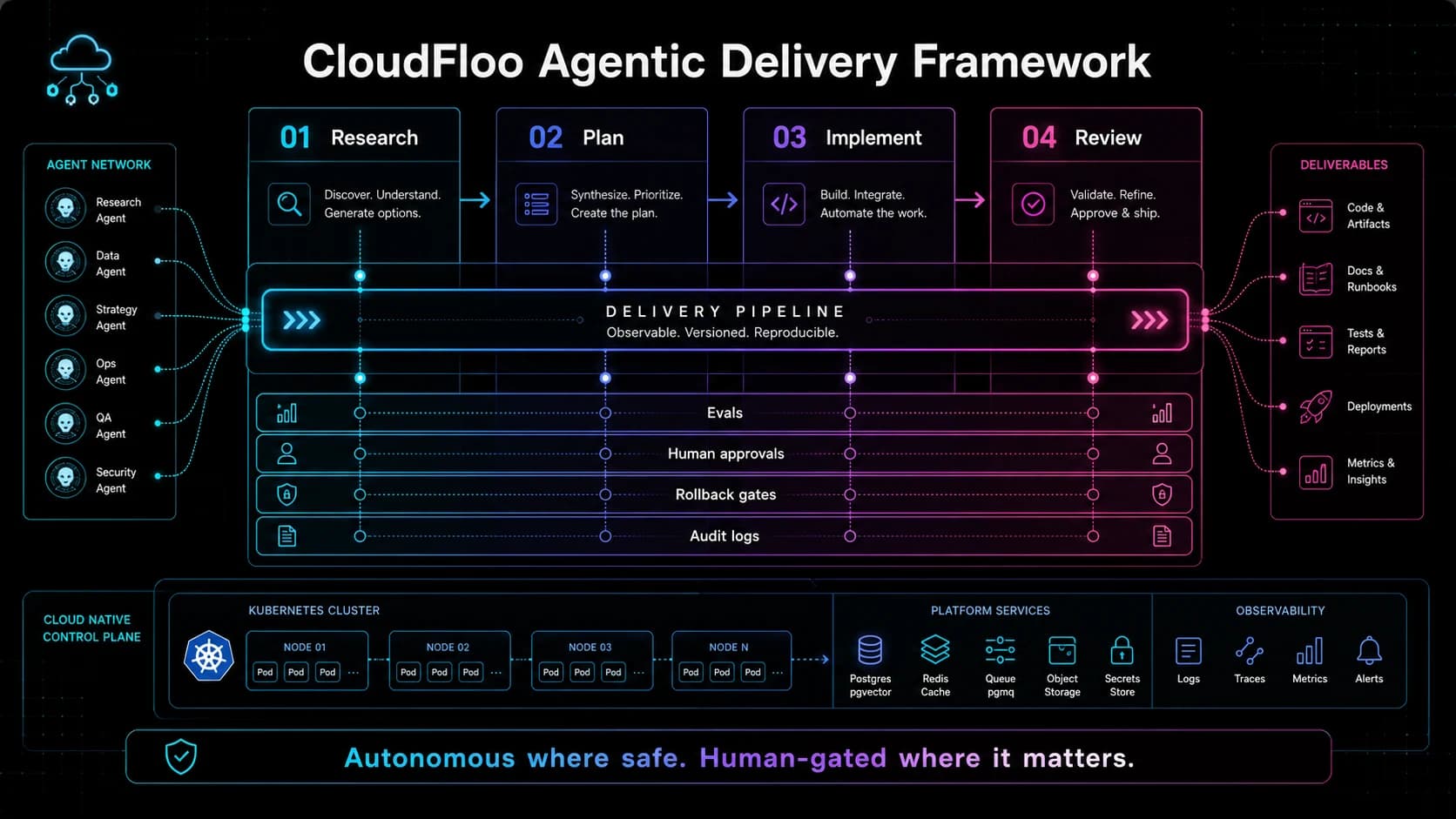
Most AI delivery copy starts with speed. That is understandable, but incomplete. Speed is useful only when the system still produces artifacts a buyer can inspect: source briefs, delivery slices, architecture decisions, tests, evals, rollback plans, and a clear owner for production risk.
CloudFloo uses agents to compress repetitive work and widen the amount of context a team can process. The useful boundary is not "agent or human." The useful boundary is "what can be automated safely, what needs review, and what must have a rollback path before it touches production."
The framework in one sentence
Autonomous where safe. Human-gated where it matters.
Agents can research, draft, compare, inspect, and propose changes. Senior engineers still own architecture, security, data boundaries, production deployment, and the final judgment on whether the system is ready.
01. Research: turn scattered context into a cited brief
The first job is not to write code. It is to understand the work. Agents are useful here because real projects have context spread across repositories, docs, tickets, analytics, customer notes, competitor pages, old decisions, and production behavior. A good research pass collects that context and makes it reusable.
The output should not be a vague chat summary. It should be a source-grounded brief: what was checked, which paths or documents matter, what is known, what is uncertain, and which claims are safe to use. That is especially important for AI and cloud work, where a wrong assumption can turn into security, cost, or reliability risk.
- Repository and architecture scans with concrete file paths.
- Customer workflow mapping in the language operators actually use.
- Competitor and market notes separated from CloudFloo-owned proof.
- Known gaps listed explicitly instead of hidden in confident prose.
02. Plan: reduce ambition to a shippable slice
A plan is useful only if it changes what the team does next. In our delivery model, the planning stage turns research into a narrow slice with architecture choices, risk notes, tests, data boundaries, and rollout sequence. The slice should be small enough to verify, but real enough to touch the target system.
This is where AI viability becomes concrete. Some work belongs to deterministic software: calculations, permissions, billing rules, migrations, and source-of-truth state. AI belongs where language, classification, retrieval, summarization, coaching, or decision support creates leverage. The plan should name that boundary before implementation starts.
- What stays deterministic.
- What the model is allowed to infer or draft.
- Which tools the agent can call.
- Which actions require approval.
- Which production actions require rollback and telemetry.
03. Implement: use agents without losing ownership
Agents can accelerate implementation across code, tests, documentation, content, and review tasks. They are strongest when the repo already has good conventions and the task has a tight scope. They are weakest when the instruction is broad, the domain model is unclear, or the system has hidden production coupling.
CloudFloo keeps the implementation layer narrow. Agents can work on bounded subtasks: add a mapper, draft a case-study page, inspect route behavior, create a test, or summarize risk. The engineer remains responsible for the final patch, the architecture, and the verification command that proves the change is not just plausible but working.
The model is not the product.
The product is the software system around it: permissions, data contracts, evals, observability, human approval, fallback behavior, and a path back when something breaks.
04. Review: evals, approval, rollback, and audit logs
Review is where agentic delivery becomes production discipline. A serious workflow needs deterministic tests for code, evals for model behavior, approval gates for risky work, telemetry for live behavior, and rollback plans for changes that can hurt customers or the company.
This matters because agent output can look polished while still being wrong. A framework article can overclaim. A code change can pass a happy path and break a boundary case. A deployment can be technically successful while the product behavior is wrong. Review turns confidence back into evidence.
- Deterministic tests for product and infrastructure behavior.
- Eval sets for prompts, retrieval, classification, and generated decisions.
- Human approval for external messages, money, data changes, and production actions.
- Rollback plans, logs, metrics, traces, and incident runbooks.
Where CloudFloo is different
CloudFloo is not trying to sell agents as magic labor. The stronger position is production AI with controls. We combine cloud-native delivery, TypeScript product engineering, Payload and CMS systems, Kubernetes and GitOps, and agent workflows that are allowed to help only inside clear boundaries.
That is why this framework connects to real proof. IndepAI, live at indepai.app, shows deterministic product logic with AI at the edges. CloudFloo v2 shows a CMS-backed site and content automation surface. Our internal operating patterns show how memory, retrieval, roles, tasks, and approvals shape agent work before it becomes a client-facing system.
Audit your agentic delivery path
CloudFloo can map your current workflow, identify safe automation lanes, and design the approval, eval, telemetry, and rollback gates before agents touch critical systems.
Get a process review